|
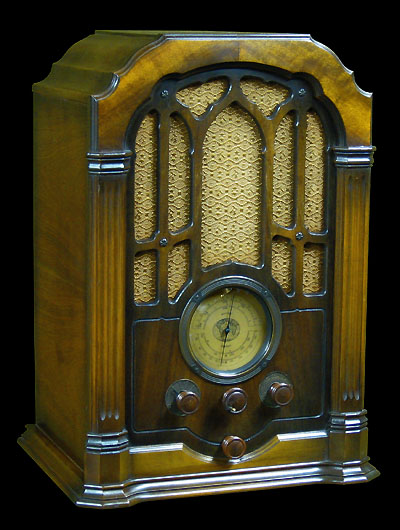
1933 RCA Victor, Radio Corporation of America, Camden, New Jersey USA |
||
|
Tube Line Up: |
||
|
Dimensions: |
||
|
Frequency Range: |
||
|
Power Source: |
||
|
Schematic & Information |
||


|
|
||
|
At Red Star Radiosite, which is maintained by Vitaly Brousnikin, you can view a couple of Russian versions of the RCA 140. Click on the links to the right. |
||
|
SVD-1 1937 ( Housed in a Russian version of the RCA T10-1 Cabinet) |
||


|
SVD-9 1938 |
||
|
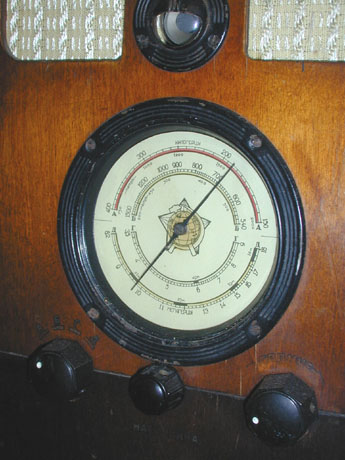
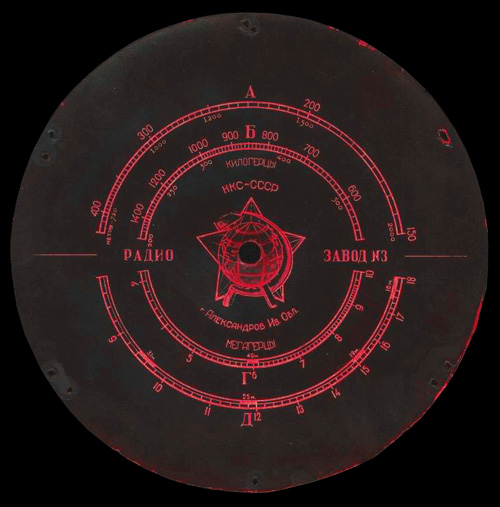
SVD-9 Dial Close Up |
||

|
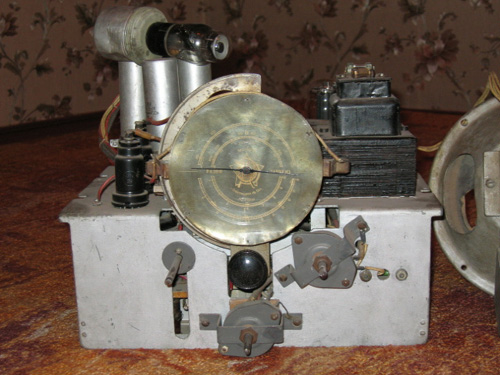
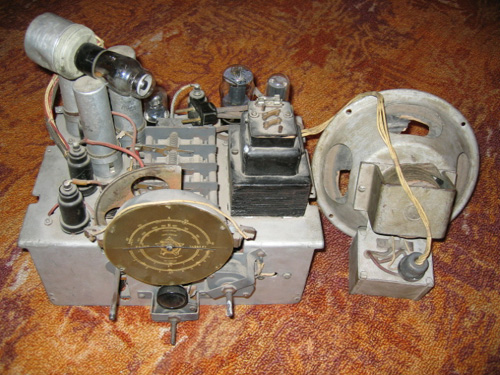
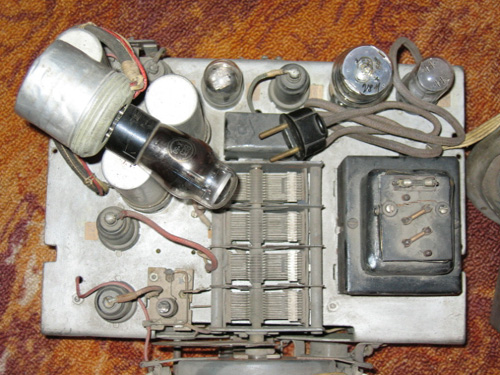
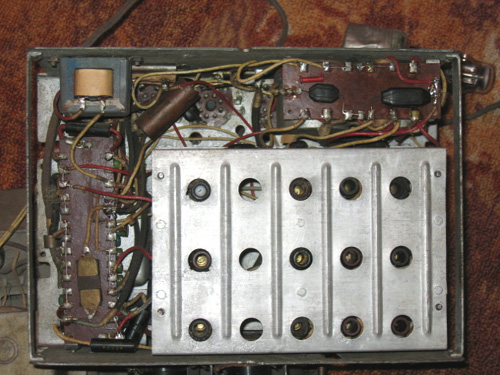
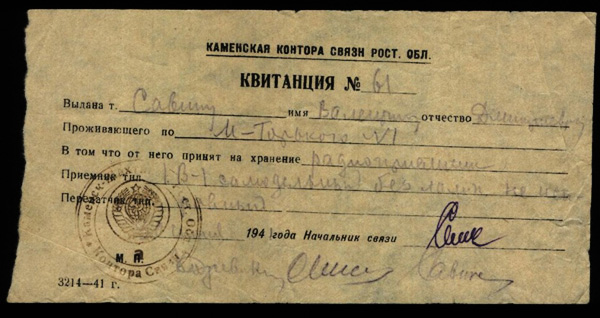
Below are photos of a SVD-9, which is a Russian version of the American RCA 140 radio. George Ukrainski, an avid antique radio collector who resides in Moscow, Russia, but works in the United Arab Emirates, submitted these photos, along with the interesting history behind this chassis, to me. In 1982 George acquired this chassis from the original owner, Savin Valentine, who was, at that time, in his 90s. Savin told George that he purchased the radio back in the mid 1930s. The Soviet Union entered WWII on June 22, 1941 and on June 25,1941, the Soviet government ordered the entire population to temporarily give up their radios to the local Post & Telegraph offices for proper storage until the wars end. Non compliance with this order would subjected any offender to "punishment according to the Laws of Military times...". The NKVD (later called the KGB) was given only 3 days to carry out the task of rounding up and storing all personally owned radios in the entire country and one can only imagine to panic and chaos that took place when the population of every city, village and rural area through out the Soviet Union struggled to haul in heavy radios of various sizes and age to the local Storage sites. At this time, Savin owned the SVD-9 but he didn't wish to completely give up such an expensive radio, and so, in risking defiance with the government's orders, he pulled out it's chassis and speaker, sealed them up tightly in a metal box with solder, and buried them in his back yard. He installed the chassis of a homebrew radio, which featured the same sized dial as the SVD-9, into the SVD-9's cabinet and handed the set over to the proper authorities for storage. This was just before he was drafted to serve in the army. Thankfully the authorities didn't notice the radio's modification and accepted it for storage, giving Savin a receipt, which he would use to reclaim the radio after the wars end. Unfortunately, during the war, the storage facility was located in an area in where there was heavy embattlement in which the Nazis were twice defeated. Soon after the end of the war, Savin was discharged from the Red Army and he immedently went to the storage facility to reclaim his radio. He found that only the homebrew chassis survived while the SVD-9 cabinet was heavily damaged. Later Savin dug up the SVD-9 chassis, which was perfectly preserved, and that is the chassis that survives today. |
||
|
The earliest dials of the SVD-9 were made of photo paper sandwiched between two sheets of clear celluloid. Later the dials were made of solid, light colored, celluloid with the bands printed in black and various colors. Still later dials were oval in shape. The bands on this dial translated into English are as follows, from top to bottom: A, B, G, and D according to the Cyrillic alphabet. Above the star is the abbreviation HKC-CCCP which stands for the People's Commissariat of Communications of USSR. Below the star is written: Alexandrov, Province of Ivanov. On either side of the star in big bold letters is written: Radio Works N3. |
||
|
|
||
|
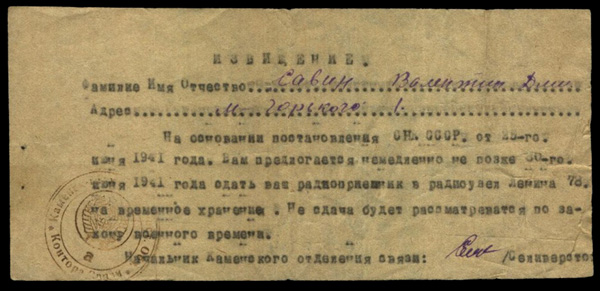
Receipt #61
|
||
|
The interesting thing about this receipt is that the radio is
identified as a 1-V-1 (single tube radio) when it was clearly a multi
tube superheterodyne. One guess in the successfulness of this
deception was that during the time of deposit, everything
was done in a rush and it was handled by non technical people. He
may also have told the officials that the original chassis was damaged
and the homebrew chassis in the cabinet represented the true radio that
he owned. Whatever the reason, he took a grave risk in
trying to pass off such an elaborate deception and he was lucky in
succeeding. It wasn't rare to have people shot in the back of the
Post Office Building for as smell of an infraction as withhold a single
tube. These executions were conducted immanently with out trial. |
||
|
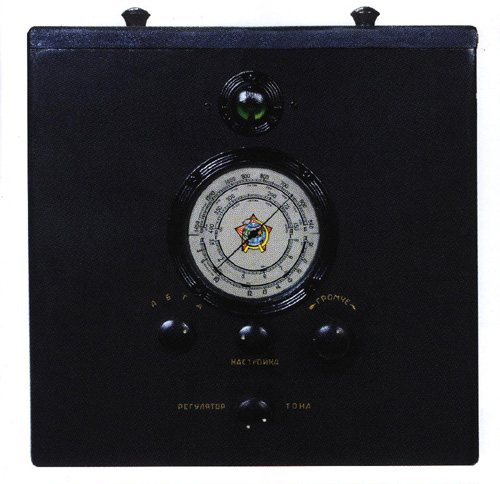
Above is another Soviet radio receiver which was based on the RCA 140 design. It's a TM-9 which was manufactured in 1941 by the Alexandrov Radio Works No. 3. It's a professional version of the SVD-9 and was designed to be used as a "translation receiver" for the Soviet cable radio system, a system which is still in use today. The photograph below, submitted to me by George Ukrainski, is from a new Russian book titled "The Red Hears", which is published in Moscow. The book has many photographs of Russian radios along with radios from other countries. There's a section in the book discussing the corporation between RCA and the Soviet Union which started in 1936. |
||

|
|
||