|
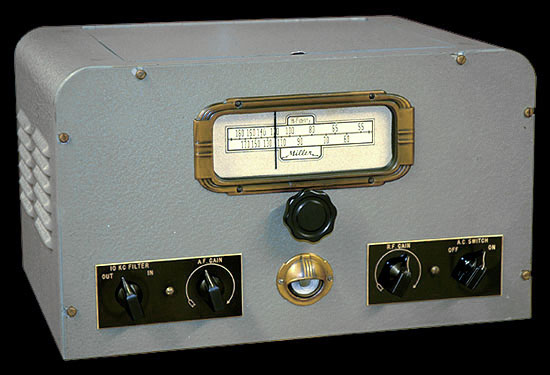
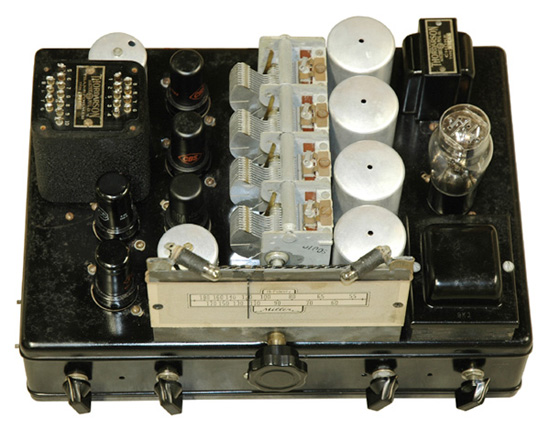
Designed for reception of programs from local stations, this TRF tuner
delivers sufficient output to drive push-pull 2A3 tubes, passes
sidebands of approximately 7.5 to 10 KC., and has sufficient adjacent
channel selectivity
This tuner was designed to meet the requirements of those
who wish high fidelity radio reception from high power local stations.
Many people have been in the market for a high fidelity receiver for
some time but have not felt like paying the money for a one-microvolt,
all-wave receiver when they wished to restrict their listening to not
over a half dozen stations delivering several millivolts of signal. The
tuner may also be used as a monitor for broadcast programs by
advertisers or any others interested only in local programs.
The selective element is made up of 4 tuned circuits in pairs
of coupled or band pass filter circuits. The coupling of negative mutual
inductance and capacitance insures a sensibly constant bandwidth, which
can be varied simply by changing the capacity of the coupling
condenser. A diode detector is fed from this selective system through an
untuned transformer. The detector is followed by a single stage of
triode a-f amplification, which provides sufficient voltage output to
load up push-pull 2A3 tubes through a proper coupling transformer.
The tuned circuits are overcoupled and exhibit the usual
curve of peaks separated by a dip at resonance. This dip amounts to
about 2 dB and is not considered serious, considering the variation in
response of the usual loud speaker. A 10,000-cycle filter made up of a
tuned trap is located in the output of the first a-f tube. In this
particular receiver, the trap can be removed at will, but in general it
is advisable to have it in the circuit. On any good night in the New
York suburbs the beat notes between stations makes it quite necessary to
use the trap. With a 7,500-cycle side band an attenuation of 60-70 dB
is necessary to eliminate monkey chatter.
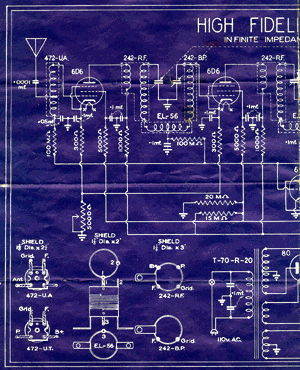
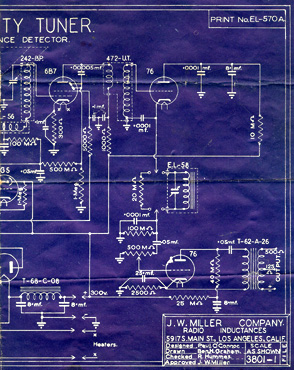
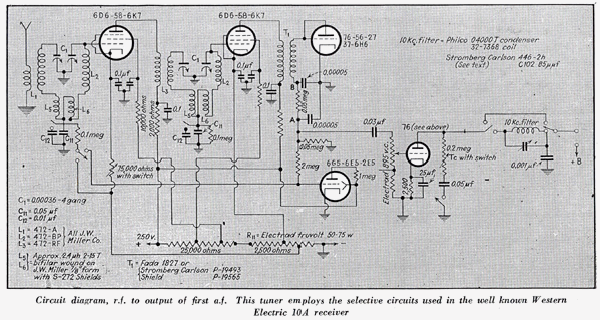
The diagram shows that the coupling impedance consists of a
negative mutual inductance, a resistance and capacity. The negative
mutuals must be wound by hand. For checking coil inductance and
condenser matching, a simple test method is to make the coil or
condenser section under test part of the oscillatory circuit of a simple
oscillator. The simplest battery-operated, unshielded oscillator will
serve although it is preferable to include a variable condenser of 15 to
25 micro-microfarads in parallel to the main oscillator tuning
capacitor. With this auxiliary condenser set at midscale the main
control may be varied until a beat is produced with a broadcast station
(picked up by the receiver) at approximately the frequency desired for
the test.
By cutting the various sections of the tuning condenser
into the oscillatory circuit, it is possible to retinue to zero beat by
the auxiliary condenser and the discrepancy in capacity may be readily
noted. By bending plates it is possible to bring the capacity back into
line. As most midget condensers are of the straight-line capacity type
the capacity per dial degree can be calculated roughly. Coils may be
checked by a similar method. The accuracy of alignment by this method
depends upon the patience of the operator. An accuracy of 0.1 per cent
is not unattainable.
The interesting circuit using the negative mutual
inductance was first described by E. A. Uehling in Electronics,
September 1930, and was used commercially in the well-known 10-A
wide-band receiver of Western Electric. That receiver, however, used a
square law detector so that modulation peaks affected the AVC action.
The present tuner utilizes a linear detector, the AVC operates only on
the carrier and is unaffected by the modulation. When the AVC is removed
for manual r-f gain control, modulation does affect the input to the
tuning indicator (6G5 on the diagram) so that a slight wavering of the
shadow is seen. This does not bother the tuning, however.
Additional data on the negative mutual inductance coupling
circuit may be found in the "Radio Engineering Handbook," 2nd Edition,
page 158, ~ in Wireless World, February 18, 1931, and in Radio
Engineering, December 1936.
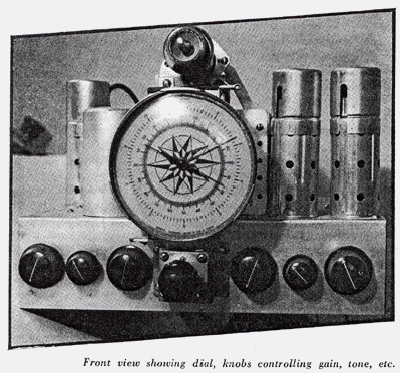
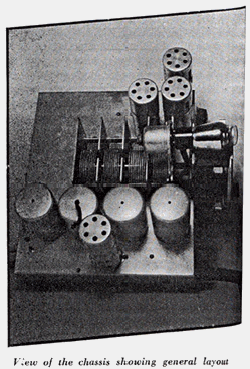
Because this tuner was to be operated by an engineer
several controls were placed in it, which would not be necessary or
desired, perhaps, for more general use. For example the slight amount of
AVC secured from the detector is fed back to the first stage and a
switch makes it possible to remove this voltage and to control the r-f
gain of the receiver manually. Selective fading seems to be tolerated
with somewhat more enjoyment when the receiver is not under AVC. A tone
control has been included in the receiver but has never been used by the
engineer for whom the set was made. When static is so bad that a tone
control is necessary, receiving is no fun anyhow. For general use the
tone control might as well not be included.
The second r-f stage must be operated with sufficient
bias, say 7 to 9 volts to prevent amplitude distortion when it is
supplying 60 volts peak at 100 percent modulation to the diode circuit,
the impedance of which is about 50,000 ohms. The audio frequency stage
is conventional except that its grid is connected to one-half the diode
load to improve the modulation capability of the detector. If
insufficient output is secured, the a.f. may be connected across the
entire diode load. When 20 volts are applied to the diode, approximately
100 volts (rms) will be applied between the grids of a push-pull
amplifier when fed by a 2-1 transformer from the first a-f stage.
There are two untuned transformers available. Both are
replacement items and may be secured from jobbers or factory branches
handling these lines. One is a Fada unit, which gives somewhat greater
output above 1200 KC., and the other is a Stromberg Carlson unit, which
is slightly more efficient below 650 KC. The Fada unit is more compact.
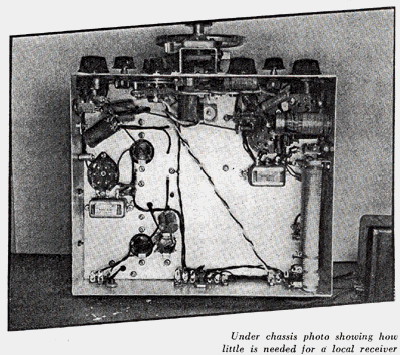
In such a receiver it is necessary to reduce as far as possible any
chance of noise entering the circuits. Grid and plate leads must be
short and direct; separate leads should run from each brush of the gang
condenser, a single point on the chassis should represent ground for
diode and a-f stages. This point should be near the diode.
After antenna, ground and power supply have been
connected, the 1st r-f screen voltage should be adjusted (by moving clip
on Electrad Truvolt voltage divider) to 125 and the cathode to plus 3.
Then the 2nd 6D6 screen voltage should be set at 125 to 150 (depending
on signal strength) and its cathode to plus 8 volts.
Then, with micro-ammeter or magic eye, proceed to align or
trim the gang condenser (Wholesale Radio Service YH9705) at 1400 to
1500 KC.
After aligning carefully, the screen voltages may need to
be reset so that with AVC operating, the weakest of the local network
stations will impress 8 to 10 volts across the diode input (80-100
microamperes through the 100,000 ohm load).
If the AVC fails to hold down the signal with greatest
field strength to 20 volts, readjust screen-grid voltages, and if no
satisfactory compromise can be made-shift the AVC connection to point B
from A, thus impressing twice the control voltage on the first r-f tube,
at the expense of a slight increase in harmonic distortion. Although
these adjustments may sound tedious, it will probably be found that they
can be accomplished in less time than that necessary to read this
portion of the paper.
Although the diagram shows the 10,000-cycle filter
(Philco) in the first a-f plate circuit, experience has shown that a
Stromberg Carlson filter is somewhat more satisfactory. It is higher in
impedance and should be placed in the diode load. The connecting leads
must be very short.
With coils as described and coupled with condensers of
0.05 µf the bandwidth is approximately 20 KC. and when shunted by an
additional 0.01 µf this bandwidth becomes approximately 15. The coils
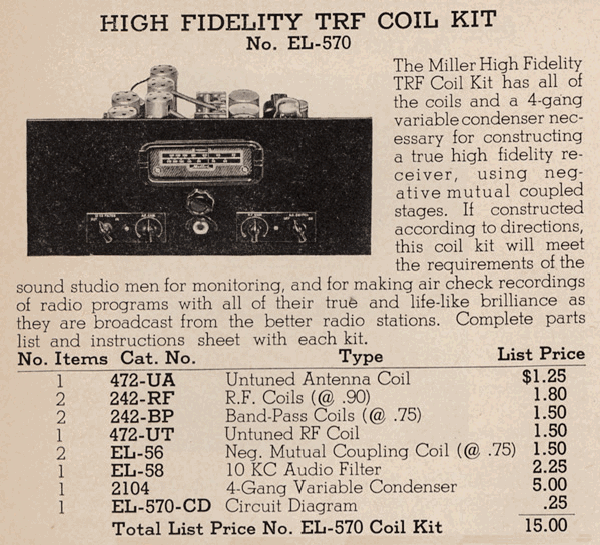
are special and to the best of the writer's knowledge may be obtained
only from J. W. Miller Co., 5917 South. The loud speaker presents a
problem. There are several fine speakers now available which are
satisfactory up to 6000 cycles or so, but the writer has found that it
takes one of the few double-unit speakers to really make a wide-band
tuner show up its capabilities. The natural resonance of the cone of the
speaker should be in the neighborhood of 30 cycles, if possible. This
calls for one of the 18-inch or similarly large dynamic types with
plenty of field excitation. Many listeners state that they find little
advantage to extending
Main St., Los Angeles. While it is desirable to check the
inductance and the capacity of the several units, it is true that
reasonable variation between values of the several units will not cause
great departure from symmetry of resonance curve nor appreciable change
in fidelity.
A Yaxley switch may be employed to change not only the
bandwidth but in the narrower position to insert the whistle filter as
well. This refinement is unnecessary unless using loud speakers, which
are flat to 10,000 cycles or better. With most single speakers, even the
so-called high-fidelity units, sharp cut off usually takes place
between six and eight thousand cycles, and little or no difference will
be noted between a 7,500 and 10,000 cycle band width.
This tuner has been designed to operate with an efficient
signal collector, because wide-band reception is worthless unless the
signal to noise ratio is high. The antenna should be at least 20 feet
away from wiring, other antennas, metal roofs, gutters, etc., and as
long as possible -at least 75 to 150 feet. A good ground plus a
noise-reducing lead-in or transmission line with a transformer at each
end are very desirable. A metal cabinet to prevent direct pick-up by
leads or condenser stators will be desirable.
The loud speaker presents a problem. There are several fine speakers now
available which are satisfactory up to 6000 cycles or so, but the
writer has found that it takes one of the few double-unit speakers to
really make a wide-band tuner show up its capabilities. The natural
resonance of the cone of the speaker should be in the neighborhood of 30
cycles, if possible. This calls for one of the 18-inch or similarly
large dynamic types with plenty of field excitation.
Many listeners state that they find little advantage to
extending the audio range into the high frequencies unless the low end
is extended at the same time. Thus a small baffle with a cut-off near
100 cycles is distinctly not good enough for faithful reproduction. The
several acoustical systems recently developed-such as the labyrinth of
Mr. Olney, the resonant pipes of RCA Victor, the resonating cones of
Philco or the "bass reflex" principle of Hugh Knowles of Jensen-may be
effectively employed. In the latter system, use is made of ports in the
speaker cabinet, which are approximately resonant in the extreme low
frequency range of the cabinet so that in relation to the cubic content,
the phase of the back radiation of the cone is reversed.
|
|